Showing posts with label Rob Bell and Catholicism. Show all posts

Tuesday, April 5, 2011

Catholic Perspective on Love Wins by Rob Bell -- Part 4 Can Non-Christians Go to Heaven?

Note: I'm currently reading Rob Bell's new and extremely popular book Love Wins. I will be posting reviews on various sections of the book as I read them while giving a Catholic perspective to the questions he poses. 

Other posts on Love Wins
Intro
Part 1--On Salvation

Part 2--On Heaven
Part 3--On Hell 

--


Bell begins chapter 1 with one of the most provocative Evangelical questions: Can non-Christians go to heaven?
 
Here's an excerpt of a story he tells:
"Several years ago we had an art show at our church. I had been giving a series of teachings on peacemaking, and we invited artists to display their paintings, poems, and sculptures that reflected their understanding of what it means to be a peacemaker. One woman included in her work a quote from Mahatma Gandhi, which a number of people found quite compelling.

But not everyone.

Someone attached a piece of paper to it. On the piece of paper was written: 'Reality check: He's in hell.'


Really?
Gandhi's in hell?
He is?
We have confirmation of this?
Somebody knows this?
Without a doubt?"

 
Bell continues to answer this question in chapter 6 of the book entitled There Are Rocks Everywhere. The meaning behind the title is taken from 1 Corinthians 10. In 1 Corinthians 10, St. Paul recounts the story of Moses and the Exodus. Specifically, St. Paul notes that Moses stuck a rock in the desert to give the people water. In recounting the story, St. Paul remarks that the rock was Christ.

Bell (and most people) find it to be odd that the rock is Jesus Christ. But, Bell uses the story to show that Jesus Christ can be present and has been present in places we might not think he has been. He is starting to build the case the Jesus' presence (and salvation) can be in places we might not think or expect.

During the chapter, Bell cuts to the chase and systematically outlines the different options in regards to Jesus' ability to save others.

First, he starts with a quote from the Gospel of John, chapter 14 where Jesus says, "I am the way and the truth and the life. No one comes to the Father except through me."

Bell notes: This is as wide and expansive a claim as a person can make. What he doesn't say is how, or when, or in what manner the mechanism functions that gets people to God through him...."

Bell then gives three options in regards to Jesus saving others.

1. Exclusivity.
"Jesus is the only way. Everybody who doesn't believe in him and follow him in the precise way that is defined by the group doing the defining isn't saved, redeemed, going to heaven, and so on...You're either in, or you're going to hell. Two groups."


2. Inclusivity
"The kind that is open to all religions, the kind that trusts that good people will get in, that there is only one mountain, but it has many paths. This inclusivity assumes that as long as your heart is fine or your actions measure up, you'll be okay."


3. Exclusivity on the other side of inclusivity.
"This kind insists that Jesus is the way, but holds tightly to the assumption that the all-embracing, saving love of this particular Jesus the Christ will of course include all sorts of unexpected people from across the cultural spectrum."

Bell chooses answer 3. For him, it is the only way to make sense of a loving God and the truth held in Scripture.

If someone has to believe in Jesus, do all the people who have never even heard of Jesus go to hell? How is this there fault? What kind of loving God would do this? Even if they have heard of Jesus, this doesn't mean they know who Jesus truly is? Same thing before applies here. Bell continues to ask the question: What would a loving God do?

So, Catholic pop quiz: Which road does the Catholic Church take?

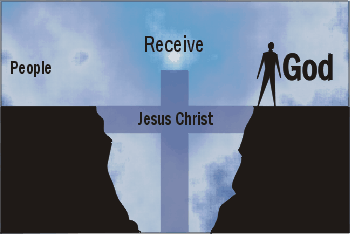
Basically, the Catholic Church believes that it is through Jesus Christ and through the Catholic Church that men and women are saved.

This being said, the Church does not limit the way that this salvation can occur. One can be outside the visible bounds of the Church, but through the justice and mercy of God, can be saved and be apart of the invisible Church. 

Note: Jesus Christ and the Church still provide the salvation, but others can be saved and be apart of the Body of Christ, even if they themselves don't know it.

Vatican II
Let's look at the Vatican II document Lumen Gentium (Light of the Nations), no. 16. (Titles mine).

Jews and Muslims
"In the first place we must recall the people to whom the testament and the promises were given and from whom Christ was born according to the flesh. On account of their fathers this people remains most dear to God, for God does not repent of the gifts He makes nor of the calls He issues.

Those who haven't heard the Gospel
Those also can attain to salvation who through no fault of their own do not know the Gospel of Christ or His Church, yet sincerely seek God and moved by grace strive by their deeds to do His will as it is known to them through the dictates of conscience.

Those who don't know about God
Nor does Divine Providence deny the helps necessary for salvation to those who, without blame on their part, have not yet arrived at an explicit knowledge of God and with His grace strive to live a good life. Whatever good or truth is found amongst them is looked upon by the Church as a preparation for the Gospel.

The need to still preach the Gospel
Wherefore to promote the glory of God and procure the salvation of all of these, and mindful of the command of the Lord, "Preach the Gospel to every creature", the Church fosters the missions with care and attention."
Even though others can be saved, the Catholic Church believes that the most direct and sure route is through Jesus Christ and the Church. People who do not know of Jesus Christ and His Church can still go to hell based on their actions. We must continue to proclaim the fullness of truth and allow men and women to find and know that which ultimately provides salvation.


In the end, Bell has a very Catholic view of how Jesus exclusively saves others while still allowing an inclusivity towards non-believers.

--

Well, I think this is my last post on Love Wins. It's been fun and I have enjoyed thinking through the different questions posed. There is still much to think about. Feel free to post a question or a thought on the book. I just might write another blog post if necessary.


Other posts on Love Wins
Intro
Part 1--On Salvation

Part 2--On Heaven
Part 3--On Hell 


Friday, April 1, 2011

Catholic Perspective on Love Wins: Part 3 What Rob Bell Says about Hell

Note: I'm currently reading Rob Bell's new and extremely popular book Love Wins. I will be posting reviews on various sections of the book as I read them while giving a Catholic perspective to the questions he poses. 

Other posts on Love Wins
Intro
Part 1--On Salvation

Part 2--On Heaven


--
A lot has been said about Rob Bell's view on hell. So much has been said it is hard for the common person hoping to get a summary of the issue to figure it all out. Even in the book itself, Bell is sometimes more concerned about telling stories and adding insights rather than a systematic argument.


In this post, I wanted to briefly cover what Rob Bell says about hell in his book (and what he doesn't say), why and how he makes these claims, and then give some resources what can help someone get a feel for the conversation around the issue. I'll give some Catholic perspective along the way as well.


What does Rob Bell say about hell?


There are many controversial aspects of the book, but the main one is this: Rob Bell makes the case that hell exists, but that it is only temporary (the majority of this argument comes in chapters 3 and 4). He believes that eventually everyone will be saved over time whether they accept the love of God in this life or the next. In Bell's words: "The love of God will melt every hard heart, and even the most 'depraved sinners' will eventually give up their resistance and turn to God." For Catholics, this is similar to what we believe about Purgatory, but Bell has transferred the concept to hell. (Catholics believe that everyone that goes to Purgatory eventually goes to heaven, but those in hell stay there--CCC 1030-1031).


Why and how does Rob Bell say this about hell?
Overall, Rob's main argument is the very character of God. 


He asks questions pertaining to: Who is God? What does God want? Does God get what he wants?


Who is God?
Bell feels that the idea of hell puts God's character on the line. Bell states, "God is loving and kind and full of grace and mercy--unless there isn't confession and repentance and salvation in this lifetime, at which point God punishes forever. That's the Christian story, right?" In sum, Bell echos the modern question that many modern men and women have: How can a loving God send people to hell forever?


Bell uses much of Chapter three to make a Scriptural case for God to redeem mankind. Specifically, he points out God's punishment of Israel and other nations only to later redeem them. For instance, Jeremiah 32: "I will surely gather them from all the lands where I banish them in my furious anger and great wrath; I will bring them back to this place and let them live in safety." He also explores the meaning and concepts behind hell in the Bible. Specifically, he questions the words that we translate into eternal.


What does God want?
God's goal is to save all people. He shows a number of passages to back this up. Here are two:


"God wants all people to be saved and to come to a knowledge of the truth" (1 Timothy 2)
"Every knee should bow...and every tongue acknowledge that Jesus Christ is Lord" (Philippians 2).


Does God get what he wants?
Bell asks: "Does this magnificent, mighty, marvelous God fail in the end?"


Will "all the ends of the earth" come, as God has decided, or only some?...Will God shrug God-size shoulders and say 'You can't always get what you want?"


First Reaction
My first reaction is that Bell is asking some fantastic questions about God. And, I think it is important not to avoid them. We must applaude him for this even if we don't agree with everything he says. These are the questions of the modern man and woman. Addressing them helps to bring Christianity to the discussion table.


Bell makes the point:
"Because if something is wrong with your God,
if your God is loving one second and cruel the next,
if your God will punish people for all of eternity for sins
committed in a few short years,
no amount of cleaver marketing
or compelling language
or good music
or great coffee
will be able to disguise 
that one, true, glaring, untenable, unacceptable, awful reality."


Second Reaction
It is important to realize that Bell is speculating this opinion rather than saying that it is an absolute truth that he knows. In the book he says: 
"Will everybody be saved, or will some perish apart from God forever because of their choice? Those are questions, or more accurately, those are tensions we are free to leave fully intact. We don't need to resolve them or answer them because we can't, and so we simply respect them, creating space for the freedom that love requires."


This quote shows that his overall argument is a lot more tame than most probably realize. I think this gets lost in the book and I think Bell could have done a better job of noting this. I think his overall goal is a conversation about the topic. But, in the end, I think most people are left with an argument because of the way that it is presented.


Third Reaction
What does the Catholic Church teach (and not teach) about this topic and what do I believe?


A few things:
1. Once in hell always in hell (CCC 1031)
2. We don't have to believe that anyone is in hell (We aren't God so we don't know).
3. We can hope that no one is.


Okay, so the Church teaches a lot more than this, but I won't cover everything here. It is funny because for all of Bell strong language, it seems like in the end he would agree with the Catholic theologian Hans Urs von Balthasar who would say we should hope that no one is in hell, but we don't know for sure (similar to Bell's quote above). Maybe, von Balthasar would have sold more copies if he had been able to make a trendy and controversial video and if he had lived in the era of twitter and blog controversy.


Bell is correct to point out all of the tensions. And, in the end, personally I feel left with tensions and not definitive answers.


I am satisfied with trusting in the justice of God for every human being. I think Bell's point is to shed light on the fact that modern men and women aren't.


Other Resources on Rob Bell's Book:
Fr. Robert Barron -- Catholic blogging priest
Darrell Bock -- Protestant Scripture scholar and editor of Christianity Today
Mark Discoll -- Popular Protestant pastor


--


What are your thoughts? Have you read the book? What opinion do you subscribe to?


Saturday, March 26, 2011

Catholic Perspective on Love Wins by Rob Bell -- Part 2 Heaven

Note: I'm currently reading Rob Bell's new and extremely popular book Love Wins. I will be posting reviews on various sections of the book as I read them while giving a Catholic perspective to the questions he poses. 

Other posts on Love Wins
Intro
Part 1--On Salvation
Part 3 -- On Hell

Chapter 2 is called Here is the New There.

The key question in the chapter: Are there other ways to think about heaven, other than as that perfect floating city hanging suspended there in the air above that obvious red and black realm with all that smoke and steam and hissing fire?

Overall, I agree with most of this chapter (there are some minor things that I don't totally buy into to). Because of their significance, I will just review the areas of agreement with Catholicism.

Area of Agreement #1--Heaven on Earth

The overall thesis of this entire chapter is that ultimately heaven will be here on earth (as alluded to in the title). Bell uses many of the images from the prophets and teachings from Jesus about the age to come to show, "It's here they were talking about, this world, the one we know--but rescued, transformed and renewed."

"When we talk about heaven, then, or eternal life, or the afterlife--or any of that--it's important that we begin with the categories and claims that people were familiar with in Jesus' first-century Jewish world. They did not talk about a future life somewhere else, because they anticipated a coming day when the world would be restored, renewed, and redeemed and there would be peace on earth."

Bell notes Revelation 21, which is an image of the end of the world, and how "God's dwelling place is now among the people."

Heaven on earth is a very Catholic concept. Catholics believe that Jesus set up His kingdom here on earth. While still not heaven, the kingdom is an image of what is to come and we are supposed to be living out heaven on earth.

Catechism of the Catholic Church: "The Church is ultimately one, holy, catholic, and apostolic in her deepest and ultimate identity, because it is in her that "the Kingdom of heaven," the "Reign of God," already exists and will be fulfilled at the end of time...Then all those he has redeemed and made "holy and blameless before him in love," will be gathered together as the one People of God, the "Bride of the Lamb," "the holy city Jerusalem coming down out of heaven from God, having the glory of God" (CCC 865).

Bell states that this perspective isn't just theoretical. It has huge implications for what we do here on earth.  He observes, "It often appears that those who talk the most about going to heaven when you die talk the least about bringing heaven to earth right now, as Jesus taught us to pray: 'Your will be done on earth as it is in heaven.' At the same time, it often appears that those who talk the most about relieving suffering now talk the least about heaven when we die."

Is this why Catholic never talk about heaven? On a serious note, it does explain Catholics strong sense of social action. No other religious or non-religious organization does more humanitarian aid each year. We specifically take the earth seriously in our teachings as well. The Pope has put solar panels on the Vatican and purchased forest space in order to offset the Vatican's carbon footprint. Not to just be green, but to reflect Catholic teaching about an earthly heaven and a renewal of the earth.

Compare Bell's quote to the Catechism quote that follows: "A proper view of heaven leads not to escape from the world, but to full engagement with it, all with the anticipation of a coming day when things are on earth as they currently are in heaven."

"Far from diminishing our concern to develop this earth, the expectancy of a new earth should spur us on, for it is here that the body of a new human family grows, foreshadowing in some way the age which is to come. That is why, although we must be careful to distinguish earthly progress clearly from the increase of the kingdom of Christ, such progress is of vital concern to the kingdom of God, insofar as it can contribute to the better ordering of human society" (CCC 1049)

Area of Agreement #2--Fire in Heaven (Purgatory?)

Rob brings up a passage in 1 Corinthians 3  about purification. To quote him directly, "(on the day that) inaugurates life in the age to come, will 'bring everything to light" and 'reveal it with fire,' the kind of fire that will 'test the quality of each person's work.' Some in this process will find that they spent their energies and efforts on things that won't be in heaven-on-earth. 'If it is burned up,' Paul writes, 'the builder will suffer loss but yet will be saved, even though only as one escaping through flames.' Flames in heaven."

To my enjoyment, Bell continues: "Much of the speculation about heaven--and, more important, the confusion--comes from the idea that in the blink of an eye we will automatically become totally different people who 'know' everything. But our heart, our character, our longings--those things take time."


All of what Rob is talking about here is exactly how a Catholic would about purgatory (Catholic confusion note: All those in purgatory go to heaven. It is a purification before the elect go to heaven.)

Catechism of Catholic Church:  "All who die in God's grace and friendship, but still imperfectly purified, are indeed assured of their eternal salvation; but after death they undergo purification, so as to achieve the holiness necessary to enter the joy of heaven.

The Church gives the name Purgatory to this final purification of the elect, which is entirely different from the punishment of the damned. The Church formulated her doctrine of faith on Purgatory especially at the Councils of Florence and Trent. The tradition of the Church, by reference to certain texts of Scripture, speaks of a cleansing fire..." (CCC 1030-1031).

Final thoughts:
Overall, I think Bell's thoughts on heaven stem from his view of salvation in chapter 1. Salvation is a process, not simply a prayer. This very much affects his purgatory like position. In addition, Bell's questioning of the Protestant tradition allows him to read the Bible outside of it. In doing so, he sees that Scripture paints a very different picture of heaven and in doing so radically changes how we act here on earth. To see all of these thoughts in one of the most popular Protestant books of the past 10 years is very encouraging.

In the end, Bell will basically transfer the idea of purgatory above to what hell is like. We will cover this next time.

Thoughts on this chapter or the book?

To close, here is a Simpsons video on the differences between Protestant and Catholic heaven--definitely worth the watch--notice the earthiness of the Catholic heaven (although it still does involve clouds).
--
Other posts on Love Wins
Intro
Part 1--On Salvation
Part 3 -- On Hell


Thursday, March 24, 2011

Catholic Perspective on Love Wins by Rob Bell -- Part 1 on Chapter 1

Note: I'm currently reading Rob Bell's new and extremely popular book Love Wins. I will be posting reviews on various sections of the book as I read them while giving a Catholic perspective to the questions he poses.

Other Posts on Love Wins:
Intro
Part 2 -- On Heaven
Part 3 -- On Hell

As I mentioned before, both Rob Bell and this book are highly controversial. Chapter 1 is no different. Bell begins by questioning how Christians are saved.

Bell poses the key question: "Isn't that what Christians have always claimed set their religion apart--that it wasn't, in the end, a religion at all--that you don't have to do anything, because God has already done it through Jesus?"

But then, gives example in Scripture where people do have to do something.

He eventually summarizes all the examples in Scripture (he actually gives a few more later).

"So is it what you say, (John 3, Luke 20)
or what you are, (John 3, Luke 20)
or what you do, (Matthew 7)
or what you say you're going to do, (Luke 19)
or who your friends are, (Mark 2)
or who you're married to, (1 Corinthians 7)
or whether you give birth to children?" (1 Timothy 2)

(Scripture verses provided in the book, but added by me to this summary quote).

I'm not sure I could have written a chapter on this any better.

Salvation and entry into the Church as a Christian is one of the most foundational acts in the Christian Church. And yet, there are so many different opinions in Christianity on how this happens exactly. Which one is it?

I love this chapter because I feel that Catholicism (and perhaps Orthodoxy and Anglicism to some degree) has a response that is able to handle the various Scripture passages and the complexity and depth of this topic. Whereas, a Christian church who only believes in saying a prayer and committing to once saved, always saved ultimately falls short.

How do Catholics handle the various claims and ways to salvation in Scripture?

Answer: Both/And; All of the Above

We believe that "being saved" or justification is an absolutely unmerited and free gift from God made possible through Jesus Christ’s death on the cross (cf. CCC 2010). This is good news. We are adopted into God’s family through God’s grace. The idea that we can save ourselves by our own actions is a heresy called Pelagianism and is condemned by the Catholic Church (cf. CCC 406).

This grace is symbolized (and is made actual) by Baptism, especially infant Baptism. The infant does nothing to merit the grace received. In fact, it is the faith of the parents and godparents that enter the baby into the Family of God (just like Bell's example in Mark 2).

We do believe that in order to be saved we must respond to God’s invitation of salvation (cf. Matthew 22:1-14, CCC 1993, CCC 2002). By the way, even this response can only be done through God's grace, but it still involves our free will (CCC 1996; 2002).We begin this pilgrimage of salvation through our Baptism and continue the process by responding with faith in words and deeds (cf. CCC 1253-1254; Matthew 7). 

The best summary on the issue I have seen is by Catholic Answers.

"I am already saved (Rom. 8:24, Eph. 2:5–8), but I’m also being saved (1 Cor. 1:18, 2 Cor. 2:15, Phil. 2:12), and I have the hope that I will be saved (Rom. 5:9–10, 1 Cor. 3:12–15). Like the apostle Paul I am working out my salvation in fear and trembling (Phil. 2:12), with hopeful confidence in the promises of Christ (Rom. 5:2, 2 Tim. 2:11–13)."

Bell's critique of Protestantism's view of salvation doesn't fall on Catholicism. It reveals a need for a Catholic perspective on the topic.

Have you read the book yet?

What are your thoughts on this chapter?

Note: Despite a more robust theology on the topic, I think Protestants have done a fantastic job of simplifying the acceptance of Jesus Christ into our lives. Historically, Catholics seem to have so much depth they fail to know how to present it to others. If we could marry this simplicity with rich Catholic theology, this would pack a powerful one-two punch. Here is one example of how to do this. If you follow the links, it works you through how to present the Gospel to someone in a Catholic context.

--

Other Posts on Love Wins:
Intro
Part 2 -- On Heaven
Part 3 -- On Hell


Tuesday, March 22, 2011

Catholic Perspective on Love Wins by Rob Bell -- Intro

I (Kevin) just started reading Rob Bell's Love Wins: A Book About Heaven, Hell, and the Fate of Every Person Who Ever Lived. I thought I would blog about a few of the chapters as a way to shed some light on the book from a Catholic perspective.

The book itself is widely popular. To give some credence to this, see this link about his blowing up the blogosphere. At one point, Rob Bell became the top trending topic on twitter (no small feat)...and this was before the book came out. Bell has been on Good Morning America and other programs to talk about the book.


Currently (March 22, 2011) the book rests at #4 on Amazon's rankings (Pope Benedict's is #25). That's not #4 out in the religion and spirituality section, but overall. The #1 book is probably the best book that I have personally read all year Heaven Is For Real.


So, why is Bell's book so popular?


First, Bell is one of the most popular pastors in America today and has been called our generation's Billy Graham. He has released incredibly popular short films called Noomas and several other books, Velvet Elvis perhaps being the most popular. He does a fantastic job of getting after questions people want answers to and does so in a way that takes a unique view of history and theology that few can pull off.


Second, this book is about hell and in particular Bell proposes that perhaps hell doesn't last forever and that eventually everyone goes to heaven. See the video promo for the book. This could be also called universalism, although Bell won't except this title and others support him in this. If you are confused with all the titles in regards to salvation, Scot McKnight wrote an article to help straighten everything out. For a really good interview with Bell on this, watch his recent interview on MSNBC.


Third, some people do not like Rob Bell. And this is their opportunity to go after him.

Personally, I really enjoy Rob Bell. I like to ask people the question, "If you could have lunch with any three living people, who would they be?" Rob Bell has been in my top 3 for the last 7 years.


But, this doesn't mean that I agree with him on everything.


I have yet to read the entire book, so I don't want to critique Bell's argument just yet. Certainly, there will be some truth in it and at other times we will have to part ways. In the end, I always enjoy Rob because he brings tough questions and the reality of Christianity to the forefront. If we merely avoid the questions, I believe Christianity ultimately become irrelevant to modern men and women. I like THAT he addresses them even if I don't always agree with the WAY that he addresses them. But, I usually walk away with a deeper perspective on the issue and a greater historical understanding. 


Of course, as a Catholic it is easier to agree to disagree with an evangelical. I don't expect to or need to agree with them on everything. If I were an evangelical, this might be a different story.


Because Bell's argument is so popular and he opens up some great questions, I wanted to give a Catholic perspective to all of it. Through it, I hope to personally come to a better understand of what the Church teaches on these subjects and why. Also, I don't think the Church has answered all of these questions definitively yet. There is room within orthodox Catholicism to wrestle with these questions. At the same time, we are fortunate enough to stand with a tradition that has wrestled with these questions for 2,000 years.


The journey should be exciting....


Have you read the book?


What are your thoughts on it so far?


--

Other posts: