Showing posts with label FOCUS. Show all posts

Saturday, October 1, 2011

Flowers for Therese

"My mission - to make God loved - will begin after my death. I will spend my heaven doing good on earth. I will send a shower of roses." St. Therese

I love embellished headbands. I'm not really sure where this obsession came from, but it's becoming rare to see me without one. For the past few weeks I have been wanting to find the time to make some headbandable felt flowers to add to my collection and today, on the feast of St. Therese, seemed to be the perfect time to do it.

We always celebrate the Feast of St. Therese because she is FOCUS' patroness and we love her. Why is a cloistered nun the patroness of a missionary organization? Glad you asked. Head over to the FOCUS equip blog to find out, my husband posted on it yesterday.

After eating our traditional rose colored and shaped pancakes Bean and I got to crafting.


The instructions on how to make them are almost identical to the instructions I posted on how to make headbands using scrapbook flowers. The only differences are replacing the scrapbook flowers with flet flowers (I printed off some patterns from Danielle's Place and used them as my guide) and sewing on buttons instead of using craft brads.

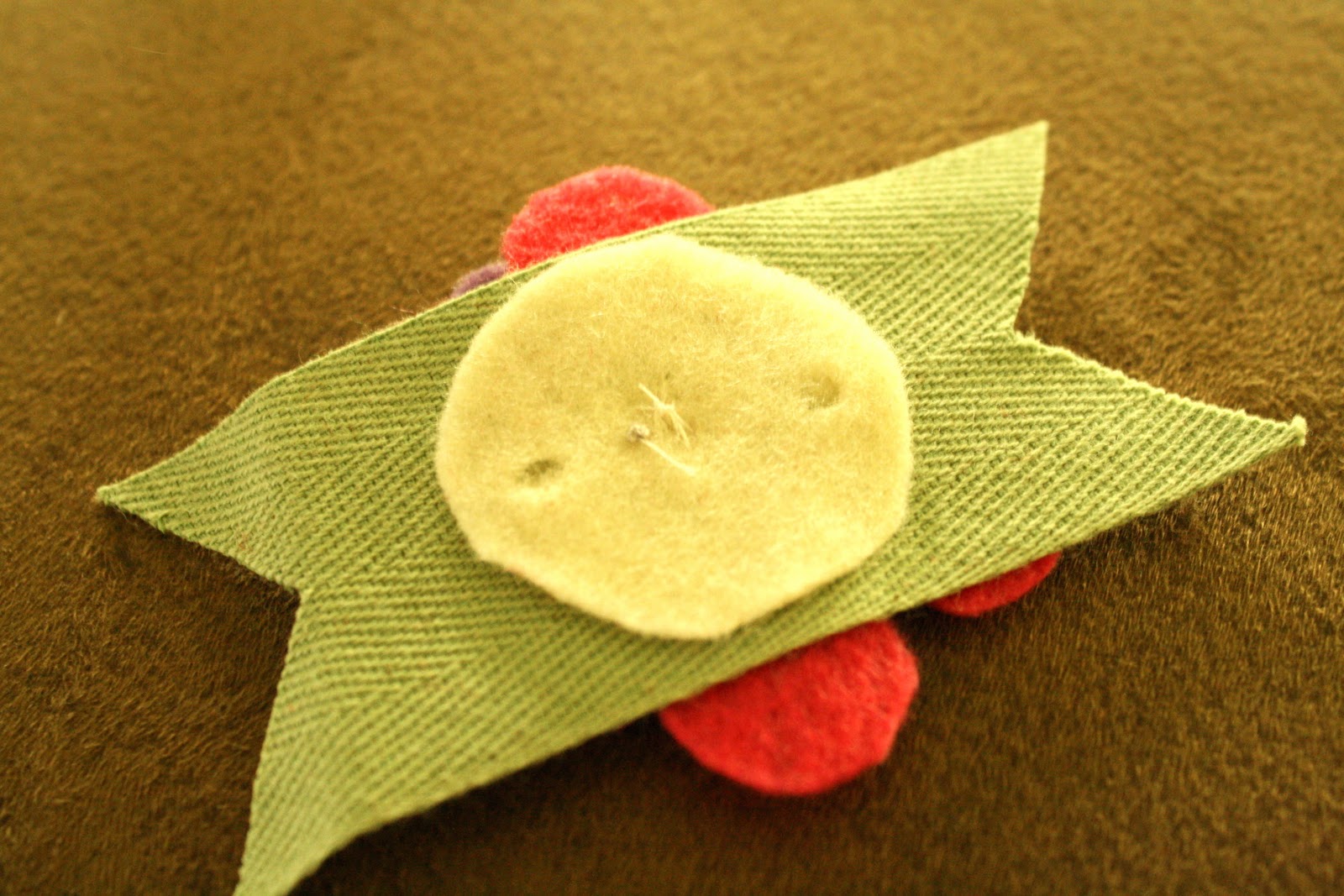
The back of a felt flower, I used ribbion with this one.

I took my inspiration from Running with Scissors who showcased some beautiful bouquets, although mine are not nearly as ornate!

Bean was a perfect model and is very excited about her new headbands...


and clips.


I think St. Therese would approve.

Later today we'll pull out the kid's books on St. Therese that we picked up in Lisieux last year, as well as our Treasure Box books that I posted on last year. I'm stilling trying to figure out a fun flower dessert, so we'll see if that happens.

Friday, January 28, 2011

St. Paul's First Letter to the Corinthians


I (Kevin) am currently writing a Bible study on 1 Corinthians. Last year, I was sitting in on a class at the Augustine Institute with some missionaries who were visiting Denver. My friend and mentor Dr. Sri was teaching the class on 1 Corinthians and made the remark to everyone, "If I were going to write one Bible study for college students, it would be 1 Corinthians." So, this year I decided to do just that.

The amazing part about 1 Corinthians is that despite being written almost 2,000 years ago there is so much application for college students (and all of us) today.

For instance, St. Paul talks about how the Corinthians trust in the wisdom of the world and the philosophies of their day instead of the wisdom of God (1 Cor. 1-2). It's easy to think the Corinthians are foolish, but then we realize how much we do this today. How do we allow the media to influence how we think and act? How do we allow the philosophies of today dampen our faith or trust in our Church? (See CCC 2727) Are we willing to stand up in the classroom for what we believe in the face of the wisdom of our professors?

One of the main issues in the letter seems to have nothing to do with us--the eating of meat sacrificed to idols (1 Cor 8-10). Some of the people in Corinth think it is okay to eat because they know that there is only one God. St. Paul reveals that they are setting a bad example for other Christians who still struggle not to worship pagan gods. They also are subjecting themselves to the temptations that the pagan temples bring--drunkenness and sexual immorality.

College students are faced with similar challenges today even if they don't involve meat sacrificed to idols. There is nothing wrong with drinking if you are over 21, but should you really go to a party that is surrounded by a culture of drunkenness and sexual immorality? Is this a good example for other Catholics on campus? What kind of temptations are you subjecting yourself to?

In a Corinthian culture that loved Olympic games, St. Paul uses an athletic analogy. If an Olympic athlete can exercise and work hard to win an event (and a crown of withered celery), how much harder should we work to preach the Gospel to others to earn an imperishable crown? (1 Cor 9:24-27). I don't have to do too much work to see how this applies to us today.

The study also addresses topics like: choosing a Vocation, the influence of the media, the Church’s teaching on contraception, the pursuit of holiness, developing the zeal to evangelize, and discerning our spiritual gifts among others.

Overall, the theme for the study on Corinthians is: What does it mean to live in the world, but not of it? We are a people set apart, but we are also called to engage the world and bring Christ to it. As our culture is beginning to look more and more like the pagan city of Corinth, my hope is that this Bible study can help students learn and live out the valuable insights of St. Paul.

(For an introduction to 1 Corinthians as a whole, check out  the study bible my friend, Mark Giszczak wrote.)

Tuesday, January 18, 2011

Holy Medal Earrings

Ladies, I am happy to bring to you the latest Catholic trend, fresh from the FOCUS conferences. The on-campus missionaries are the ones who keep me up to date on trendy ways to share your faith with style, so today I'm happy to pass their wisdom on to you.

Presenting, holy medal earrings...


"Where in the world can I get these?", you ask. "They are so cute!" I know, I know, but remember, I didn't invent them... I'm not sure who did. I believe some vendors were selling them at the conferences, but I decided to make my own.

All you need are medals and hooked wire, found in the jewelry making section at any craft store.


I suggest mini-medals, as opposed to the standard sized medals, but you can do whatever you want, they are your ears. One missionary even had the big circle St. Benedict medals, those were awfully stylish too. I bought about 50 mini Miraculous Medals for 3 euros when I was in Rome in college and still have several that I haven't given away. They were blessed by JP II.... it's pretty sweet. If you want me to send you a pair of medals, post a comment and I'll hook you up.


I removed the wire loop on top of the medal so they face out as opposed to the side.


Then I slid them on the loop. Neither of these tasks required any special tools, I just used my hands to pull the metal apart.


Now you too can be the cutest Catholic in your pew. 

(I took that picture myself, with the help of my bathroom mirror, I felt very innovative for a few minutes.)

Wednesday, December 8, 2010

Solemnity of the Immaculate Conception

Today's Solemnity confuses many Catholic's because it is often thought to be a celebration of the conception of Jesus, but mathematically this would be a confusing time to celebrate Jesus' conception with the celebration of his birth in just a few weeks. 

In fact today's Solemnity celebrates the conception of Mary who was filled with grace inside her mother, St. Anne's, womb. We see this when the Angel Gabriel greets Mary at the Annunciation with "Hail, full of grace". If you know your Greek, which I'm sure you all do, you know that this phrase translates to "Chaire, Kecharitomene". Kecharitomene is in the past perfect participle, so it is an action that has been and continues to be, so it would be better translated "Hail, you who have been graced". 

This truth of Mary's Immaculate Conception was further expressed when Mary appeared to the young St. Bernadette in Lourdes, France 150 years ago. When St. Bernadette asked Mary what her name was she responded "I am the Immaculate Conception", a phrase that puzzled the uneducated St. Bernadette and shocked the clergy of the time who were still trying to understand the nature of Mary's conception. It's not that this truth about Mary had changed, it always was and will be, it's just that it took the Church a while to fully understand it and the fulness of it's beauty.


This May, while in France, we were able to visit the grotto where Mary appeared to St. Bernadette, it is pictured above. It was a truly beautiful and moving experience. We were amazed at the overwhelming amounts of pilgrimages who continue to travel to this holy place entrusting their illnesses to the healing waters of the miraculous spring (5 million each year).

Each night there is a candlelight procession for Our Lady, this picture doesn't even give justice to the size of the crowd, you can't even see how far back they go.... and we were there during a low season.


Kevin had the day off today because working for FOCUS is awesome. All major solemnities (holy day's of obligation) are taken as a day of prayer and observance for the staff. To celebrate today we started off with a yummy cinnamon flop with blue icing, for Mary of course.


I love the recipe because it take about 10 minutes to mix up. The recipe says 5 minutes, but I must be slow. I would definitely add the egg and vanilla, which say optional. It is a great alternative to the painstaking task of homemade cinnamon rolls.


We also read the pro-life book Angel in the Waters to the kids which introduces the idea of life starting at conception. You can get it for FREE(!) here, they even pay for the shipping.

This book was a great way to start a conversation on what Immaculate Conception means, as well as why Mary was so special from the time she was conceived in St. Anne's belly.

Monday, November 22, 2010

Verbum Domini: A Summary


Pope Benedict’s Apostolic Exhortation Verbum Domini
A Summary by Kevin Cotter

On November 11th, Pope Benedict released a document entitled Verbum Domini. Verbum Domini addresses the Word of God in the Life and Mission of the Church. It has been called the most important document on the Word of God since Vatican II’s Dei Verbum. I find this document to be of particular importance to the vision and mission of FOCUS and I wanted to take some time to summarize the document and pull out some valuable quotes that apply to the work of FOCUS. I expected the document to focus on the Word of God. While it certainly does this, I was happily surprised to see how much the document focused on the work of evangelization.

If you want to read the document yourself, you can find it here: http://www.vatican.va/holy_father/benedict_xvi/apost_exhortations/documents/hf_ben-xvi_exh_20100930_verbum-domini_en.pdf  (The link here is a great because it provides you with a book-like pdf that you can print out. This is much more reader friendly than most documents found on the Vatican website). I will also cite section numbers (rather than page numbers) so you can go to the document and read specific areas that might interest you.

Before I dive into the document, I want to give a little background. This document was created after the Bishop’s Synod in 2008 on the Word of God. A synod is a think-tank of sorts where Bishops from around the world gather to discuss an important issue in the life of the Church. (Note: The next synod in 2012 will take up the topic of the New Evangelization). After the synod, a document is created to properly communicate the results of the meeting. In this case, it took about two years. While the Bishops obviously contributed to much of the document, it is apparent that Pope Benedict had a great deal to do with it.

The document is broken up into three main sections (plus an introduction and conclusion):
  1. Verbum Dei--a more academic analysis of the Word of God found in Scripture and Tradition
  2. Verbum in Ecclesia--a look at how the Word of God influences the life of the Church
  3. Verbum Mundo--an examination of how the Word of God can be used to preach the Gospel to the world
I will break down the document by starting with the introduction and then by going through the three different sections followed by a conclusion.

Introduction
The introduction begins with some reflections on the overall theme of the document and some notes on the Synod itself.

Some quotes worth mentioning:

“I encourage all the faithful to renew their personal and communal encounter with Christ, the word of life made visible and to become his heralds” (no. 2).

“There is no greater priority than this: to enable the people of our time once more to encounter God” (no. 2).

The bishops placed the text of the Bible at the centre of the assembly, “in order to stress anew something we risk taking for granted in everyday life: the fact that God speaks and responds to our questions” (no. 4). 

Finally, the introduction ends with by announcing that the Prologue of John’s Gospel will be a constant reference throughout the document. The Word, in this Prologue, was with God from the beginning and comes to dwell among us. In a sense, this Prologue is a Scriptural meditation as you read through the document. 

Section One--Verbum Dei (The Word of God)
To begin this section, the Holy Father looks at the Word of God throughout Salvation History. The practice of Salvation History, looking at God’s plan of salvation throughout history, is mentioned seven times in the document. I always enjoy it when authors practice what they recommend. This won’t be the first time.

A few excerpts that stood out to me in this section:

“The Christian is not a ‘religion of the book’: Christianity is the religion of the word of God”, not of ‘a written and mute word, but of the incarnate and living Word” (no. 7).

My favorite quote of the entire document. It gives Jesus’ role in Salvation History a whole new meaning for me. This has Biblical scholar/musical genesis written all over it:

“Calling to mind these essential elements of our faith, we can contemplate the profound unity in Christ between creation, the new creation and all salvation history. The word of an author who expresses himself through the ‘symphony’ of creation. In this symphony one finds, at a certain point, what would be called in musical terms a ‘solo’, a theme entrusted to a single instrument or voice which is so important that the meaning of the entire work depends on it. This ‘solo’ is Jesus...The Son of Man recapitulates in himself earth and heaven, creation and the Creator, flesh and Spirit. He is the centre of the cosmos and of history, for in him converge without confusion the author and his work” (no. 13).

Then, there is a beautiful quote on Mary's relationship to Scripture: “Mary is the image of the Church in attentive hearing of the word of God, which took flesh in her. Mary also symbolizes openness to God and others; an active listening which interiorizes and assimilates, one in which the word becomes a way of life (no. 27).


Several quotes in this section seem to echo Hebrews 4:12: "For the word of God is living and active, sharper than any two-edged sword, piercing to the division of soul and spirit, of joints and marrow, and discerning the thoughts and intentions of the heart." The Word of God is not dead, but is alive and powerful. This will set up the other two sections as they will focus on how to live out the Word of God.

There are many more gems on Scripture in this section, but in an effort to not overwhelm, let’s continue through the rest of the document.

Section Two--Verbum in Ecclesia (The Word in the Church)
This section focuses on the role of Scripture in the life of the Church. In particular, it looks at Scripture's relationship to the liturgy. Don’t get me wrong; I enjoy the liturgy. But, for some reason, this section seems to address some very practical and specific areas that I did not find as engaging as the other two sections. This does not mean you might not enjoy it more. Here are a couple of sections I found notable for the Church in America.

There was a call to forgo giving generic and abstract homilies which obscure the directness of God’s Word (no. 59). When we fail to preach the Word of God, we either intentional avoid its message or do not proper use the power of God’s Word. Rather, the document stresses presenting Christ at the center of homilies.

The document also addresses Scripture and its relation to music. “Preference should be given to songs which are of clear biblical inspiration and which express, through the harmony of music and words, the beauty of God’s word. We would do well to make the most of those songs handed down to us by the Church’s tradition which respect this criterion. I think in particular of the importance of Gregorian chant” (no. 70). 

A common problem with music currently played in Church around the US is not only out of date modern music (70s and 80s), but also music that strays from Scripture and often addresses nature instead. Here is a call to move back to a tradition of Scripture-based music which gives the faithful another opportunity to encounter the Word of God during the liturgy. 

The document also added some practical notes for marriages and families. The Synod suggested that every family have a Bible and that it be kept in a worth place for reading and prayer (no. 85). It also stresses forming small communities of families, where common prayer and meditation on passages of Scripture can be cultivated.

Finally, of note, there is a great section on lectio divina (no. 87).

Section Three--Verbum Mundo (The Word in the World)
In terms of FOCUS, section three is by far the most important. The Word of God and the new evangelization take center stage in this section as the very mission of the Church. The title of this section is: “The Church’s Mission: To Proclaim the Word of God to the World.” Notice the proclamation of the Word of God is not one element of the mission or one piece of the mission but the mission of the Church. In a sense, this section appears to sum up many of the missionary documents we have seen in the past (Evangelii Nuntiandi and Redemptoris Missio) while taking them to a new level.

A quick note: It is easy to confuse what is meant by the new evangelization or mission ad gentes. The term new evangelization is often thrown around so much, we fail to grasp exactly what it means. The new evangelization and mission ad gentes both have specific audiences or situations in which evangelization occurs. The new evangelization is the situation where baptized Catholics "have lost a living sense of the faith." The mission ad gentes is where the Gospel is not known or mature Christian communities have not been formed. Here is a straightforward excerpt from John Paul II’s of Redemptoris Missio if you want to read more on this. Specifically read number 33.

Here are some notable excerpts from the third section of Verbum Domini:
“This is why the Church is missionary by her very nature. We cannot keep to ourselves the words of eternal life given to us in our encounter with Jesus Christ: they are meant for everyone, for every man and woman” (no. 91).

“The Synod of Bishops forcefully reaffirmed the need within the Church for a revival of the missionary consciousness present in the People of God from the beginning” (no. 92).

“The Synod reaffirmed that ‘the mission of proclaiming the word of God is the task of all of the disciples of Jesus Christ based on their Baptism’...A consciousness of this must be revived in every family, parish, community, association, and ecclesial movement. The Church, as a mystery of communion, is thus entirely missionary, and everyone, according to his or her proper state in life, is called to give an incisive contribution to the proclamation of Christ” (no. 94).

“At the dawn of the third millennium not only are there still many peoples who have not come to know the Good News (mission ad gentes), but also a great many Christians who need to have the word of God once more persuasively proclaimed to them, so that they can concretely experience the power of the Gospel. Many of our brothers and sisters are ‘baptized, but insufficiently evangelized (new evangelization)’ ” (no. 96) (remarks in parentheses are mine).

Four paragraphs that very specifically apply to FOCUS missionaries:
“The Synod paid particular attention to the proclamation of God’s word to the younger generation. Young people are already active members of the Church and they represent its future. Often we encounter in them a spontaneous openness to hearing the word of God and a sincere desire to know Jesus. Youth is a time when genuine and irrepresible questions arise about the meaning of life and the direction our own lives should take. Only God can give the true answer to these questions” (no. 104).


Evangelization on campus: “It is not a matter of preaching a word of consolation, but rather a word which disrupts, which calls to conversion and which opens the way to an encounter with the one through whom a new humanity flowers” (no. 93).

Bible Studies: “In a particular way, young people need to be introduced to the word of God ‘through encounter and authentic witness by adults, through the positive influence of friends and the great company of the ecclesial community” (no. 97). 

Discipleship: “Young people need witnesses and teachers who can walk with them, teaching them to love the Gospel and to share it, especially with their peers, and thus to become authentic and credible messengers” (no. 104).

If you are out of college and would like to live out this document, you can apply to be a FOCUS missionary here.

Conclusion
The conclusion continues the theme of the Word of God and the new evangelization:
“Our own time, then, must be increasingly marked by new hearing of God’s word and a new evangelization. Recovering the centrality of the divine word in the Christian life leads us to appreciate anew the deepest meaning of the forceful appeal of Pope John Paul II: to pursue the missio ad gentes and vigorously to embark upon the new evangelization, especially in those nations where the Gospel has been forgotten or meets with indifference as a result of widespread secularism” (no. 122).

The document closes in a very compelling and fitting way. Pope Benedict practices what he preaches by using the Word of God to take part in the mission ad gentes and the new evangelization:

“Finally, I turn to every man and woman, including those who have fallen away from the Church, who have left the faith or who have never heard the proclamation of salvation. To everyone the Lord says: ‘Behold, I stand at the door and knock; if anyone hears my voice and opens the doors, I will come in to him and eat with him, and he with me’ ” (Rev. 3:20) (no. 124). 


I will continue to read over the document and I am sure there is much more to discover. I highly recommend picking up the document yourself and reading it, especially the third section.  Feel free to post on what stood out to you.

Wednesday, November 17, 2010

Pilgrim and Indian "Hats"


Last night around 9:00 pm I was feeling crafty, so I made some pilgrim and indian hats for the FOCUS Thanksgiving potluck today! I of course forgot my camera, so just imagine adults and kids wearing these while eating turkey and mashed potatoes.

When I was a hall director at Benedictine we made hundreds of these for the school cafeteria's Thanksgiving dinner, so the idea was already in my head. These are almost too simple to give instructions for, but I figured out some tricks so I'll pass them on. Be sure to make some for you Thanksgiving festivities!

Indian:


Step 1: Cut a piece of brown construction paper into 8 strips.

Step 2: Cut feathers out of red, yellow and orange construction paper. I folded the paper so I could cut out 4 at a time.

Step 3: Glue 3 feathers in the middle of a brown strip.

Step 4: Add another strip to the strip with feathers. Now you are ready to loop it on a festive Thanksgiving guest!

Pilgrim:

Step 1: Cut a piece of black construction paper into 8 strips, just like shown above with brown.

Step 2: Cut a piece of black construction paper in to 4 hats. Look at that, you don't waste any of the paper!

Step 3: Cut out buckles from white paper. I just fold them and cut out the middle.

Step 4: Glue a strip to the back of the hat. I glued them just on the edge of the strip so the hat's "brim" pops out.

Step 5: Glue  on the buckle and another strip to the first strip so it is long enough to wrap around a head.

Saturday, October 16, 2010

Chick Flicks and Chastity

That was not taken at
UNC, but you get the idea.
In high school I was voted "Most Likely to become a Motivational Speaker", well, I guess they kind of got it right. Last year at the FOCUS national conference in Orlando I gave a breakout session titled "What Chick Flicks and Love Songs have to do with Chastity", it was for men only.

Perhaps I am crazy. What female willingly agrees to addresses a group of solely college men on chastity and women's emotions?

The weeks before the talk I spent a lot of time praying and blessed be God, the Holy Spirit showed up. From that talk I have received a number of requests to give versions of it for other events and one such event was just this week.

The FOCUS team at UNC- Greeley invited me to speak at their women's night about this topic often called "emotional chastity". It was so great to spend some time on a FOCUS campus doing hands on ministry. As my only experience on a FOUCS campus is Benedictine, which is a Catholic bubble, I was so exciting to witness a thriving program at a public university. The love that existed between the missionaries and students was apparent and you could tell that they really had a great community of faith.

The basic concept behind emotional chastity is that men and women are different in the way they were made, so they are different in the way they are tempted, specifically when it comes to purity. Men, being more physical and visual in nature, struggle with the physical side of purity. They are tempted to have unchaste thoughts and actions. Women on the other hand are more emotional and relational, so they are tempted to do things like "mentally stalk" men (almost obsessively daydream about men who they aren't even in a relationship with) and use men to try and fill an emotional void. Emotional purity and physical chastity are so interconnected because for women, where our hearts go, our bodies tend to follow.

The interconnectedness of sensual (physical) and sentimental (emotional) love is all within the wisdom of the Catholic Church from writers such as St. Teresa Benedicta of the Cross, also known as Edith Stein, and Pope John Paul II and the more I learn about it the more I understand myself as a woman, as well as the struggles that I continue to see reoccurring in the the young adults I am blessed to present to. So as long as God wants me to put myself in potentially awkward situations (for example, two of my upcoming talks will be given in bars), I'm going to continue to read up on all things related to relationships, emotions and women.


"The strength of a woman lies in the emotional life." St. Teresa Benedicta of the Cross

Friday, October 1, 2010

The Feast of St. Therese of Lisieux

Our flower cake

There are many perks to being a Catholic missionary, one is not having to work on special feast days! The Feast of St. Therese of Lisieux is one of those days for us because St. Therese, who is the patroness of missionaries, is also the patroness of FOCUS.

Today's Feast of St. Therese was even more meaningful to us  this year because in May we had the incredible opportunity of going to Lisieux, France. After reading so much about St. Therese and spending time meditating on her "little way" it was very moving to be in the actual places of the stories I know so well. We visited her childhood home and sat in the room where she was miraculously healed, I cried the whole way through the house. We also went to the Carmelite convent where she spent her years as a religious sister and prayed at her grave, as well as to her beautiful Basilica where her parents Bl. Louis and Bl. Zelie rest. I am so grateful for that experience and feel the prayers of St. Therese for our missionary family stronger than ever.
The Basilica
St. Therese's childhood home
Her grave at Carmel
Because Kevin had the day off today we slept in and then made rose colored pancakes and Kevin, the pancake master, made mine in the shape of roses. We also made a flower cake using silicon cupcake molds and read a bunch of St. Therese stories from our Treasure Box books. We just love these 1950's books that are filled with Catholic stories, games and activities. We bought all 20 at once and have been slowly giving them to Bean on special occasions.

These gems were written by the
MaryKnoll sisters in the 1950s

Some pages from a story about little
St. Therese